JointBrex Official Website › Articles › Label analysis
Label analysisJointBrex Ingredients: JointBrex® Ingredients: #1 Doctor Reviewed Label Breakdown [2026]
JointBrex ingredients, as printed on the Supplement Facts panel, are eight: glucosamine sulfate 1,000 mg, boswellia extract 133.3 mg, chondroitin sulfate 100 mg, turmeric root 100 mg, and quercetin, methionine, MSM and bromelain at 16.7 mg each, for 1,400 mg a serving. The advertising names six. MSM and bromelain are the two it leaves out, and the panel declares crustacean shellfish.
Eight on the container, six in the advertising
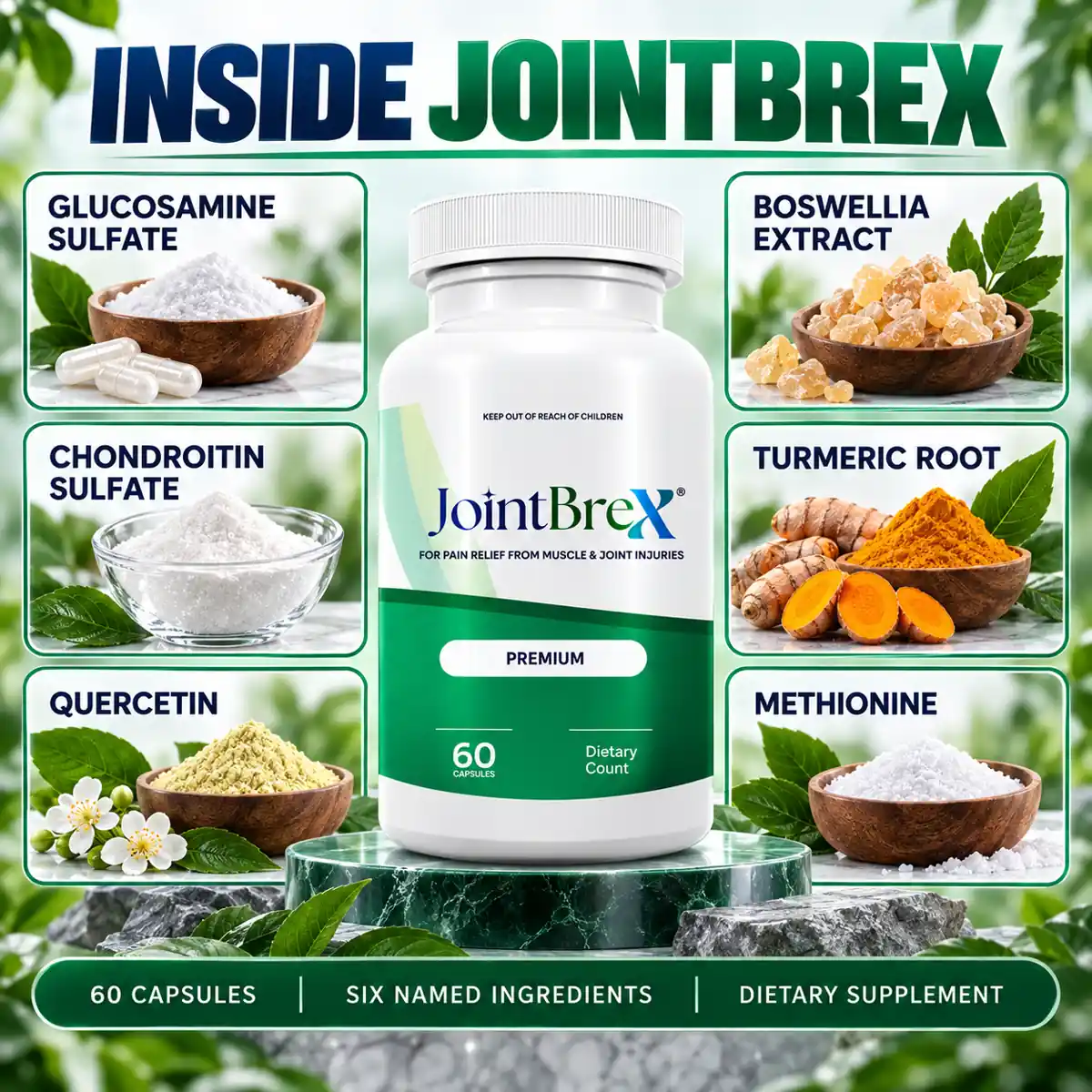
The Supplement Facts panel on the JointBrex bottle declares eight ingredients with an amount beside each. The seller's ingredient section names six, and the INSIDE JOINTBREX graphic drawn from it prints “six named ingredients” along its foot.
The two missing from the advertising are MSM and bromelain. Both are printed on the container a buyer receives, and both have randomised human trials in the exact condition this product is sold for.
What follows is product information rather than clinical guidance, and JointBrex is a supplement rather than a therapy. Heat, swelling, locking, a recent injury or a joint that is worsening steadily all call for an examination instead of a purchase; NIAMS sets out what is worth reporting.
Which direction this gap runs, and why that matters
The familiar version of this comparison runs the other way. A marketing page promises an ingredient the panel does not contain, or implies an amount the panel does not carry, and the buyer discovers the difference after paying.
Here the panel is the generous document. Whatever went wrong went wrong in the copywriting rather than in the formulation, because the panel is the regulated statement and the graphic is not. What arrives in the parcel is the eight.
That is a better problem to have, and it is still a problem, for one specific reason: the graphic is what most buyers will actually see. A person choosing between two bottles on a listing page is comparing marketing to marketing, and this product's marketing undersells its own panel.
| Ingredient | On the panel | In the advertising | Randomised trials in knee osteoarthritis |
|---|---|---|---|
| Glucosamine sulfate | 1000 mg | Named | Many, including GAIT |
| Boswellia extract | 133.3 mg | Named | Several, pooled in a 2024 meta-analysis |
| Chondroitin sulfate | 100 mg | Named | Many, pooled by Cochrane |
| Turmeric | 100 mg | Named | Several, pooled in a 2016 meta-analysis |
| Quercetin | 16.7 mg | Named | None. One trial, in rheumatoid arthritis |
| Methionine | 16.7 mg | Named | None at any amount. The studied molecule is S-adenosylmethionine |
| MSM | 16.7 mg | Not named | Yes, a pilot trial at 6 g a day |
| Bromelain | 16.7 mg | Not named | Yes, two trials at 800 mg a day |
The last column counts randomised controlled trials of the single ingredient in knee osteoarthritis, not laboratory or animal work.
Read the last column on its own. Four of the eight ingredients here have a direct randomised trial record in this condition. The advertising has dropped two of those four and kept two ingredients that have none.
What MSM actually has behind it
Methylsulfonylmethane is an organic sulfur compound. Its clinical record in joints is small but real: a pilot randomised trial gave 3,000 mg twice daily for twelve weeks to adults with knee osteoarthritis and reported improvements in pain and physical function against placebo.
A safety and applications review puts the studied range at 1.5 to 6 grams a day and finds it well tolerated across it. That is a thinner evidence base than glucosamine's and a thicker one than quercetin's, which is the comparison that matters here.
The amount on this panel is 16.7 mg — about three tenths of one per cent of the pilot trial's daily amount. Its presence is honest; its amount is a gesture. But a gesture that is printed is still better than one that is not, and it is odd to leave it out of the advertising.
And what bromelain has behind it
Bromelain is a mixture of proteolytic enzymes from the stem of the pineapple. A placebo-controlled pilot study and a sixteen-week trial scored on the WOMAC index both used 800 mg a day in knee osteoarthritis, and a 2025 crossover trial of an oral enzyme combination containing bromelain reported reductions in systemic inflammation markers, in urinary CTX-II — a cartilage breakdown marker — and in pain.
Sixteen point seven milligrams is about 2% of 800 mg. There is a second problem with this line as printed: enzyme activity is normally declared in GDU or FIP units rather than in milligrams, because two preparations of the same weight can differ several-fold in activity. This panel gives neither.
Order JointBrex from the panel that names eight
The container declares eight ingredients with amounts. This website prints all of them, including the two the advertising leaves out.
One bottle $89 · six bottles $294 · 60-day money-back guarantee
Order JointBrex From This CounterLot JOI-26/JO-3706 · 1,400 mg a serving across eight printed lines · dispatched inside the United States
The two named ingredients with no knee trial at all
The other half of this comparison is rarely made, and it is the more interesting one. Two of the six ingredients the advertising does name have no randomised trial in knee osteoarthritis at any amount.
Quercetin
A flavonoid from the flower bud of the Japanese pagoda tree. Its clinical record in a joint condition is a single trial: 500 mg a day for eight weeks in women with rheumatoid arthritis, which reported improvements in early-morning stiffness and pain.
Rheumatoid arthritis is an autoimmune disease with a different mechanism from the wear-related stiffness this product is sold for, so even that trial is an approximate guide. The panel amount is 16.7 mg, about 3% of what the trial used, in a different condition.
Methionine
An essential sulfur-bearing amino acid that comes from ordinary food. A normal day of eating supplies on the order of a gram, roughly sixty times the 16.7 mg in this capsule.
The molecule with an osteoarthritis literature behind it is S-adenosylmethionine, a different compound the body makes from methionine, studied at 600 to 1,200 mg a day. The two are routinely confused, the names are one word apart, and nothing on this panel is S-adenosylmethionine.
So the advertising has dropped two ingredients with direct randomised trials in this condition and kept two with none. That is the sentence worth carrying away from this article, and it is checkable in a few minutes from the bottle and a search engine.
What this costs the product, and what it costs a buyer
It costs the product two of its four best-evidenced names, which is a self-inflicted wound rather than a deception. It costs a buyer almost nothing in what arrives, and a good deal in what they can compare.
There is also a third cost that is easy to miss. A marketing page that is careless about its own ingredient list is a marketing page whose other claims deserve less weight, and this one has a second problem in the same neighbourhood: the numbered reference list at its foot is about gut microbiota, Gymnema sylvestre, grape seed, green tea and African mango in type 2 diabetes. Not one of the ten entries concerns a joint.
- Read the panel, not the graphic. It is the regulated document and it is what arrives.
- Count the ingredients yourself. A marketing page saying “six named ingredients” against a panel naming eight is a thirty-second check anyone can run.
- Treat the sales page's science as decoration. When a reference list belongs to a different product category, it tells you how much attention went into it.
- Give the panel the credit it deserves. Eight amounts, no proprietary blend, and an allergen line where the regulation asks for one. That is a better label than most of this aisle.
Two more things on that page that belong to another product
The missing ingredients are not an isolated slip. Two other parts of the seller page have the same character, and both are checkable in a couple of minutes.
The reference list
The page closes with a numbered list headed Scientific References: ten entries, each with an author, a journal and a year. They cover gut microbiota in type 2 diabetes, Gymnema sylvestre and sugar cravings, grape seed extract and insulin sensitivity, green tea extract and metabolic health, and African mango and appetite.
Not one of the ten concerns a joint, a cartilage, or any ingredient on this panel. It is the reference list of a blood-sugar product, left on a joint page.
The five bonus guides
The three- and six-bottle packs add five digital guides. Four of the five titles are about nerves and neuropathy: Nerve Renew, Natural Nerve Recovery, Renewed Nerves Challenge, and a recipe guide whose own description lists neuropathy symptoms. Only the fifth, a usage guide, is about this product.
They are free additions rather than a reason to buy, and that is the weight to give them. Their stated values add up to $289, more than the three-bottle pack costs and within $5 of the six, which is a marketing device rather than a price anyone paid.
None of that changes what is in the capsule, and this article keeps the two apart. What it changes is how much weight the rest of that page deserves, and the answer is to read the panel instead.
The honest summary
JointBrex declares more than it advertises, which is the rarer and more forgivable direction for this kind of error. The eight amounts are printed, six of them are well below the amounts their trials used, and two of the ingredients the marketing forgot are among the better-evidenced things in the capsule.
Everything above is checkable in a few minutes from the bottle and from the seller's own page. That is the whole argument for buying on a panel: it is the one document in this transaction that has to be true. The transcription is on the panel page and the ingredient-by-ingredient comparison is on the ingredients page.
- Kim LS, Axelrod LJ, Howard P, et al. Efficacy of methylsulfonylmethane (MSM) in osteoarthritis pain of the knee: a pilot clinical trial. Osteoarthritis Cartilage. 2006;14(3):286-94. PMID 16309928. https://pubmed.ncbi.nlm.nih.gov/16309928/
- Butawan M, Benjamin RL, Bloomer RJ. Methylsulfonylmethane: Applications and Safety of a Novel Dietary Supplement. Nutrients. 2017;9(3):290. PMID 28300758. https://pubmed.ncbi.nlm.nih.gov/28300758/
- Brien S, Lewith G, Walker AF, et al. Bromelain as an adjunctive treatment for moderate-to-severe osteoarthritis of the knee: a randomized placebo-controlled pilot study. QJM. 2006;99(12):841-50. PMID 17121765. https://pubmed.ncbi.nlm.nih.gov/17121765/
- Kasemsuk T, Saengpetch N, Sibmooh N, Unchern S. Improved WOMAC score following 16-week treatment with bromelain for knee osteoarthritis. Clin Rheumatol. 2016;35(10):2531-40. PMID 27470088. https://pubmed.ncbi.nlm.nih.gov/27470088/
- Henrotin Y, Pap T, Lieten S, et al. Oral enzyme combination therapy reduces systemic inflammation, urinary CTXII and pain in knee osteoarthritis: a proof-of-mechanism, randomised, crossover, double-blind, placebo-controlled trial. RMD Open. 2025;11(3):e005433. PMID 40803821. https://pubmed.ncbi.nlm.nih.gov/40803821/
- Javadi F, Ahmadzadeh A, Eghtesadi S, et al. The Effect of Quercetin on Inflammatory Factors and Clinical Symptoms in Women with Rheumatoid Arthritis: A Double-Blind, Randomized Controlled Trial. J Am Coll Nutr. 2017;36(1):9-15. PMID 27710596. https://pubmed.ncbi.nlm.nih.gov/27710596/
- Clegg DO, Reda DJ, Harris CL, et al. Glucosamine, chondroitin sulfate, and the two in combination for painful knee osteoarthritis. N Engl J Med. 2006;354(8):795-808. PMID 16495392. https://pubmed.ncbi.nlm.nih.gov/16495392/
- Dalmonte T, Andreani G, Rudelli C, Isani G. Efficacy of Extracts of Oleogum Resin of Boswellia in the Treatment of Knee Osteoarthritis: A Systematic Review and Meta-Analysis. Phytother Res. 2024;38(12):5672-5689. PMID 39314013. https://pubmed.ncbi.nlm.nih.gov/39314013/
- Singh JA, Noorbaloochi S, MacDonald R, et al. Chondroitin for osteoarthritis. Cochrane Database Syst Rev. 2015;1:CD005614. PMID 25629804. https://pubmed.ncbi.nlm.nih.gov/25629804/
- Daily JW, Yang M, Park S. Efficacy of Turmeric Extracts and Curcumin for Alleviating the Symptoms of Joint Arthritis: A Systematic Review and Meta-Analysis of Randomized Clinical Trials. J Med Food. 2016;19(8):717-29. PMID 27533649. https://pubmed.ncbi.nlm.nih.gov/27533649/
- National Institute of Arthritis and Musculoskeletal and Skin Diseases. Osteoarthritis. U.S. National Institutes of Health. https://www.niams.nih.gov/health-topics/osteoarthritis