JointBrex Official Website › Articles › Ingredient deep dive
Ingredient deep diveJointBrex Glucosamine Sulfate: 1,000 mg Against A Studied 1,500 mg
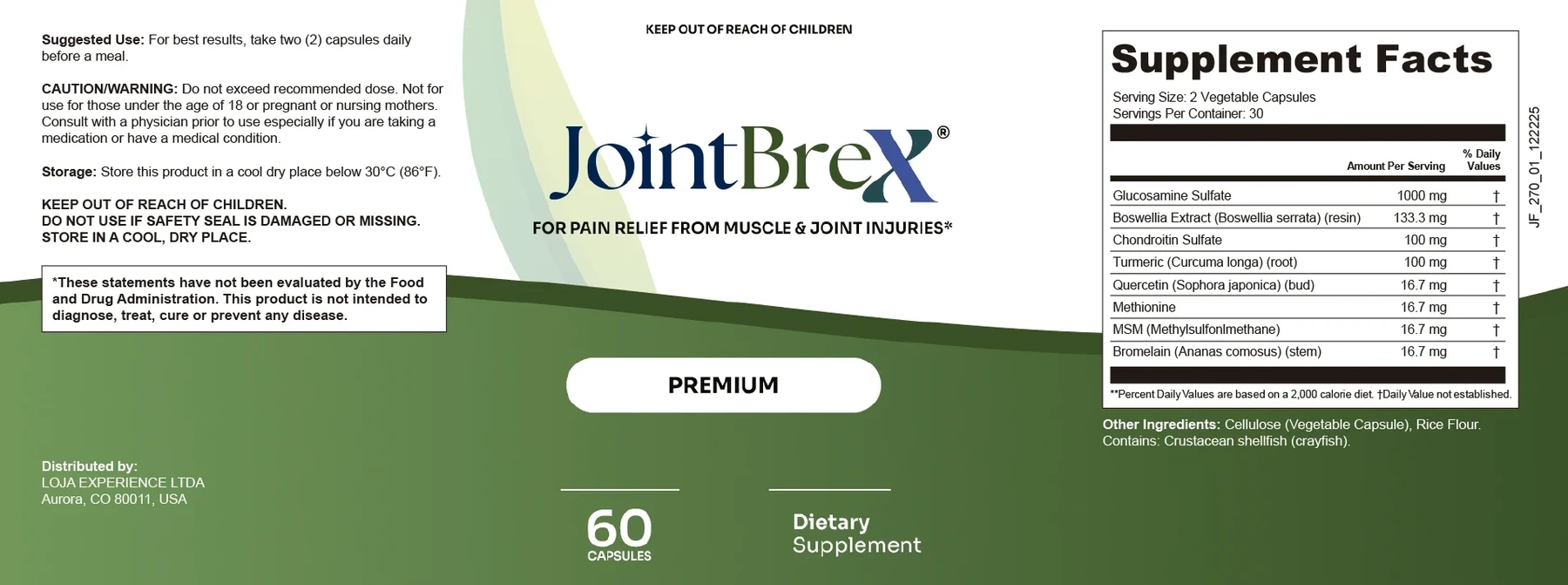
The panel carries 1,000 mg of glucosamine sulfate, which is 71% of the whole serving and two thirds of the 1,500 mg used in GAIT, in the Cochrane review and in the three-year European trials. No trial of 1,000 mg exists, so nobody can say what two thirds buys.
One thousand against one thousand five hundred
Glucosamine sulfate is 1,000 mg of a 1,400 mg serving on this panel — 71% of everything in the two capsules, and the only line close enough to its studied amount to be worth arguing about.
The amount the trials used is 1,500 mg a day. That is the figure in GAIT, in the Cochrane review and in the three-year European trials. One thousand is two thirds of it. This article is about what that third is worth.
What follows is product information rather than clinical guidance, and JointBrex is a supplement rather than a therapy. Heat, swelling, locking, a recent injury or a joint that is worsening steadily all call for an examination instead of a purchase; NIAMS sets out what is worth reporting.
Where 1,500 mg came from in the first place
The figure is not arbitrary and it is not a marketing round number. It is the amount used by the European trials of glucosamine sulfate from the 1980s onwards, taken once a day as a sachet dissolved in water, and every subsequent trial has copied it so that results could be compared.
The three-year Lancet trial randomised patients to 1,500 mg of glucosamine sulfate or placebo and reported slower joint-space narrowing on radiographs. GAIT, the large US trial, used the same daily amount — though of glucosamine hydrochloride, split across three doses — and reported no overall benefit.
That difference between the two trials, the salt and the dosing schedule, is the whole of the twenty-year argument about this ingredient. What both sides agree on is the amount.
What two thirds of a studied amount means
There is no trial of glucosamine at 1,000 mg a day in knee osteoarthritis to point at, so nobody can say what two thirds of the amount does. Three things can be said honestly.
- It is the right order of magnitude. A capsule at 100 mg of glucosamine would be a gesture. One at 1,000 mg is in the same conversation as the trials, which is more than most multi-ingredient joint formulas manage.
- Dose-response has not been mapped for this ingredient. Nobody has run the trial that would tell you whether 1,000 mg gives two thirds of the effect, all of it, or none. Anyone who tells you otherwise is guessing.
- The base effect being scaled is itself contested. If the honest reading of the literature is that 1,500 mg produces a small effect at best, then two thirds of that is a small fraction of a small number.
A buyer who wants glucosamine sulfate and would rather see the number than not is getting a real amount here, printed on the panel, with no proprietary blend hiding it. That is a genuine argument for this bottle. It is not an argument that the bottle inherits a trial result, and this desk will not make one.
What the missing third could have bought
Two capsules hold roughly 1,400 mg between them, so every milligram is contested. It is worth asking what the formula could have done with the 500 mg it did not spend on glucosamine.
| Option | What it would take | What the evidence says |
|---|---|---|
| Glucosamine at the full 1,500 mg | The whole remaining 400 mg plus another 100 mg | No room for anything else at all. A single-ingredient product. |
| Chondroitin at a studied amount | 800–1,200 mg, which is impossible here | MOVES paired 1,200 mg with 1,500 mg of glucosamine and reported non-inferiority to celecoxib at six months. |
| Boswellia at a characterised 250 mg | Another 117 mg on top of the 133.3 mg already there | The 2024 meta-analysis is the most favourable recent evidence for any botanical in this category. |
| MSM at a studied amount | 1,500–6,000 mg, which is impossible here | The knee pilot trial used 6 g a day for twelve weeks. |
| Bromelain at 800 mg | Another 783 mg, which is impossible here | The 16-week WOMAC trial used 800 mg a day. |
Amounts are per day, as used in the cited trials.
Read that table and the shape of the constraint is obvious. A two-capsule serving can carry one joint ingredient at a studied amount, or several at token amounts. It cannot do both, and no amount of formulation skill changes the arithmetic.
This panel has chosen the first option and then added seven token lines on top. A different formula could have chosen boswellia at a characterised 250 mg and spent the rest on almost nothing else, which would have been a defensible choice too. What no two-capsule product can do is deliver four joint ingredients at the amounts their trials used.
Order JointBrex on the amount, not the adjective
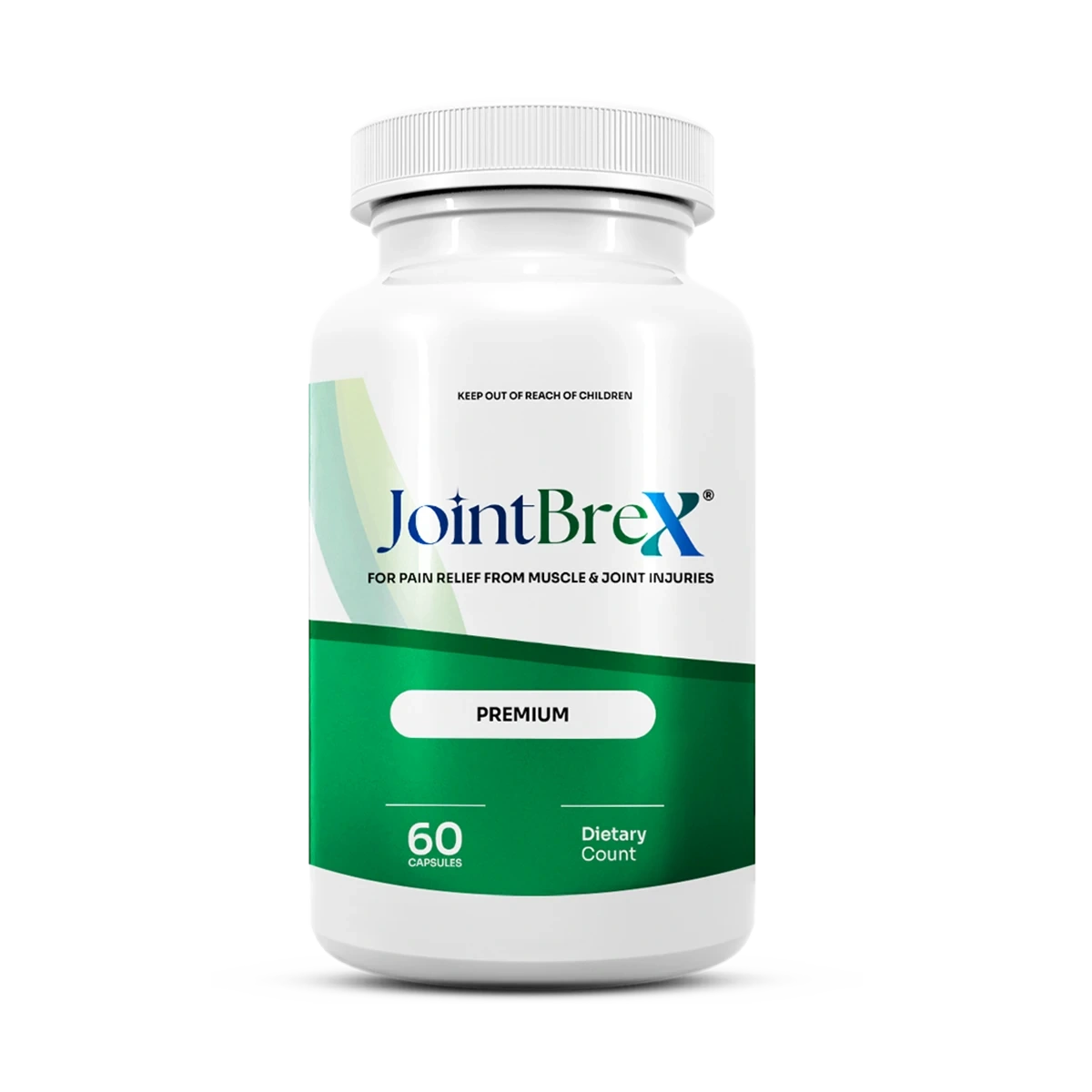
1,000 mg of glucosamine sulfate printed on the panel, and the other seven amounts printed beside it.
One bottle $89 · six bottles $294 · 60-day money-back guarantee
Order JointBrex From This CounterLot JOI-26/JO-3706 · 1,400 mg a serving across eight printed lines · dispatched inside the United States
The word before the amount: sulfate against hydrochloride
This panel does not say “glucosamine”. It says glucosamine sulfate, and on a joint label that word is doing more work than most buyers realise.
Glucosamine is sold as two salts. The sulfate form is what the European trials used, taken as a single daily dose dissolved in water. The hydrochloride form is cheaper to manufacture, carries more glucosamine per gram, and is what GAIT used, split across three doses a day.
Why anybody cares
Because the two bodies of evidence point different ways and the salt is one of the few differences between them. The three-year Lancet trial of glucosamine sulfate reported slower joint-space narrowing; GAIT, using the hydrochloride, found no overall benefit.
Supporters of the sulfate form argue the sulfate ion itself matters, or that once-daily dosing produces a different plasma profile from three smaller doses. Critics point out that the sulfate trials came largely from one manufacturer and one research group. Both observations are true, and the argument has not been settled by a trial designed to settle it.
What it means for this panel
It means this bottle is on the side of the argument with the more favourable results, at two thirds of the amount those results were produced with. That is a more interesting position than either “glucosamine works” or “glucosamine does not”, and it is the honest one.
It also means a shopper comparing two bottles should read the word before the amount. A label quoting 1,500 mg of glucosamine hydrochloride and one quoting 1,000 mg of glucosamine sulfate are not straightforwardly rankable, and anybody who tells you they are has skipped the part of the literature that makes this interesting.
How to check this on any bottle in the aisle
The method takes about ninety seconds and works on any joint supplement, including the ones that look more impressive than this one.
- Find the serving size first. Two capsules here. A label quoting 1,000 mg per capsule is a different product from one quoting 1,000 mg per two.
- Find the lead amount. The panel is ordered by weight, so it is the first line.
- Divide by the trial amount. 1,500 mg for glucosamine, 1,200 mg for chondroitin, 800 mg for bromelain, 6 g for MSM.
- Add the whole panel up. If the total is under about 1,500 mg, you are looking at a two-capsule product and the constraint above applies.
- Check for a proprietary blend. If the amounts are pooled into one figure, none of the above can be done at all, and that is the answer.
Run that on this panel and you get: one ingredient at two thirds, one in range but uncharacterised, and six between 0.3% and 12% of their studied amounts. The full comparison is on the JointBrex ingredients page, and the panel itself is transcribed on the Supplement Facts page.
What happens if you already take a glucosamine product
Glucosamine, chondroitin, MSM and turmeric are all sold individually and all appear in dozens of multi-ingredient formulas. Taking two bottles that share an ingredient means adding two amounts together, and nobody is keeping that total for you.
Why it matters more here than usual
Because 1,000 mg is already a substantial share of a studied 1,500 mg. A second product carrying 500 mg puts the daily total at the trial amount, which is a defensible place to be; one carrying 1,500 mg puts it at two and a half thousand, which no trial has tested.
The same arithmetic runs the other way for the small lines. Adding a dedicated MSM product at 3 g a day makes the 16.7 mg here irrelevant rather than additive, and a reader who understands that will stop paying twice for the same ingredient.
The practical version
- Lay both panels side by side and add the shared lines together.
- Compare each total with the trial amount, not with the label of either bottle.
- Where one product already carries a studied amount, the second one is buying you only the ingredients it does not share.
- Take both labels to a pharmacist if any prescribed medicine is involved, because the interaction question scales with the total rather than with the number of bottles.
So is 1,000 mg enough?
Nobody knows, and anyone who says they do is selling something. What can be said is narrower and more useful.
The Cochrane review and GAIT between them describe an ingredient whose effect at the full amount is small, contested and slow. Both current guidelines — ACR 2019 and OARSI 2019 — decline to recommend it. Against that background, two thirds of the amount is a reasonable thing to try and a poor thing to depend on.
The practical advice is the same one this website gives everywhere: buy the pack you can walk away from, write the purchase date down, and use the 60-day window for what it is actually for.
- Clegg DO, Reda DJ, Harris CL, et al. Glucosamine, chondroitin sulfate, and the two in combination for painful knee osteoarthritis. N Engl J Med. 2006;354(8):795-808. PMID 16495392. https://pubmed.ncbi.nlm.nih.gov/16495392/
- Towheed TE, Maxwell L, Anastassiades TP, et al. Glucosamine therapy for treating osteoarthritis. Cochrane Database Syst Rev. 2005;(2):CD002946. PMID 15846645. https://pubmed.ncbi.nlm.nih.gov/15846645/
- Reginster JY, Deroisy R, Rovati LC, et al. Long-term effects of glucosamine sulphate on osteoarthritis progression: a randomised, placebo-controlled clinical trial. Lancet. 2001;357(9252):251-6. PMID 11214126. https://pubmed.ncbi.nlm.nih.gov/11214126/
- Hochberg MC, Martel-Pelletier J, Monfort J, et al. Combined chondroitin sulfate and glucosamine for painful knee osteoarthritis: a multicentre, randomised, double-blind, non-inferiority trial versus celecoxib. Ann Rheum Dis. 2016;75(1):37-44. PMID 25589511. https://pubmed.ncbi.nlm.nih.gov/25589511/
- Dalmonte T, Andreani G, Rudelli C, Isani G. Efficacy of Extracts of Oleogum Resin of Boswellia in the Treatment of Knee Osteoarthritis: A Systematic Review and Meta-Analysis. Phytother Res. 2024;38(12):5672-5689. PMID 39314013. https://pubmed.ncbi.nlm.nih.gov/39314013/
- Kim LS, Axelrod LJ, Howard P, et al. Efficacy of methylsulfonylmethane (MSM) in osteoarthritis pain of the knee: a pilot clinical trial. Osteoarthritis Cartilage. 2006;14(3):286-94. PMID 16309928. https://pubmed.ncbi.nlm.nih.gov/16309928/
- Kasemsuk T, Saengpetch N, Sibmooh N, Unchern S. Improved WOMAC score following 16-week treatment with bromelain for knee osteoarthritis. Clin Rheumatol. 2016;35(10):2531-40. PMID 27470088. https://pubmed.ncbi.nlm.nih.gov/27470088/
- Kolasinski SL, Neogi T, Hochberg MC, et al. 2019 American College of Rheumatology/Arthritis Foundation Guideline for the Management of Osteoarthritis of the Hand, Hip, and Knee. Arthritis Rheumatol. 2020;72(2):220-233. PMID 31908163. https://pubmed.ncbi.nlm.nih.gov/31908163/
- Bannuru RR, Osani MC, Vaysbrot EE, et al. OARSI guidelines for the non-surgical management of knee, hip, and polyarticular osteoarthritis. Osteoarthritis Cartilage. 2019;27(11):1578-1589. PMID 31278997. https://pubmed.ncbi.nlm.nih.gov/31278997/
- National Institute of Arthritis and Musculoskeletal and Skin Diseases. Osteoarthritis. U.S. National Institutes of Health. https://www.niams.nih.gov/health-topics/osteoarthritis