JointBrex Official Website › Articles › Allergen
AllergenThe JointBrex Shellfish Declaration, And Who It Rules Out
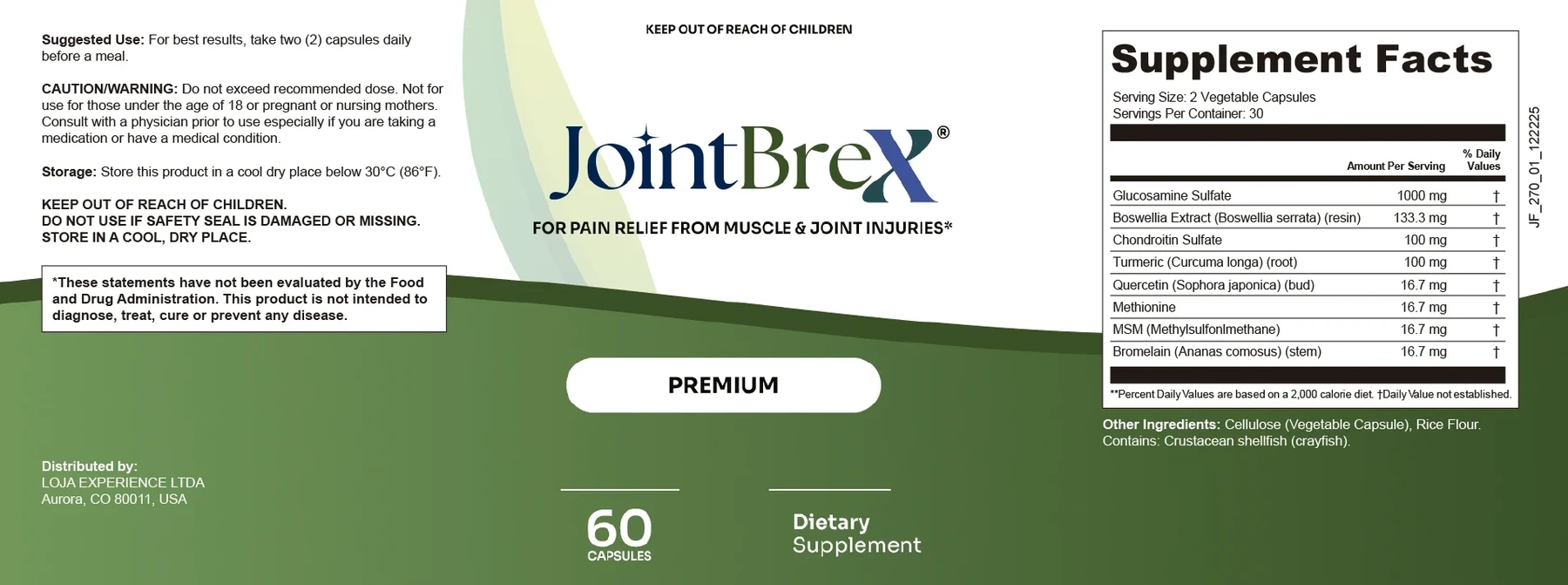
The panel prints Contains: Crustacean shellfish (crayfish). Glucosamine for supplements is commonly manufactured from crustacean shell, and glucosamine sulfate is 1,000 mg of a 1,400 mg serving here. For anyone with a shellfish allergy that line is an exclusion rather than a caution.
The line under the other ingredients
Below the eight actives and below the two other ingredients, the JointBrex panel prints one more sentence: Contains: Crustacean shellfish (crayfish).
It is set small, it is easy to miss, and it rules out a whole group of buyers completely. On a label where the largest ingredient is 1,000 mg of glucosamine sulfate, it is arguably the most consequential line on the bottle.
What follows is product information rather than clinical guidance, and JointBrex is a supplement rather than a therapy. Heat, swelling, locking, a recent injury or a joint that is worsening steadily all call for an examination instead of a purchase; NIAMS sets out what is worth reporting.
Why a joint supplement declares shellfish at all
Glucosamine for supplements is most commonly manufactured from chitin, the structural material in the shells of crustaceans — shrimp, crab, lobster, and in this case crayfish, which the panel names specifically. Chitin is hydrolysed to glucosamine and then stabilised as a sulfate or hydrochloride salt.
That manufacturing route is why almost every glucosamine product in the world carries a crustacean allergen declaration. It is also why this capsule is neither vegetarian nor vegan even though its shell is cellulose: the ingredient inside it is not plant material.
A smaller number of products use glucosamine fermented from corn, which carries no shellfish declaration. This is not one of them, and the panel says so plainly rather than leaving it to be inferred.
| What the label prints | What it means | Who it affects |
|---|---|---|
| Contains: Crustacean shellfish (crayfish) | The product contains material derived from crustacean shell. | Anyone with a shellfish allergy. |
| Other Ingredients: Cellulose (Vegetable Capsule), Rice Flour | The shell and the filler. Neither contains gluten, dairy or soy. | Coeliac and dairy-avoiding buyers, favourably. |
| Vegetarian emblem shown with the product | The capsule shell contains no gelatin. It says nothing about the contents. | Nobody, on its own: vegetarians and vegans should go by the first line. |
| Naturally gluten free emblem | No gluten-bearing ingredient was used. No gluten testing is claimed. | Worth knowing the word 'naturally' is doing that work. |
The first two rows are transcribed from the label artwork supplied with this product; the last two are emblems shown alongside it.
Who should leave this bottle alone, and how firmly
This is not a caution to be managed carefully. It is an exclusion.
The ingredient carrying the declaration is not a trace component or a processing aid. It is 1,000 mg of a 1,400 mg serving — 71% of what is in the two capsules. Taking a smaller amount to see what happens is not a sensible experiment with a declared allergen, and nothing on this website suggests it.
- Anyone with a diagnosed shellfish allergy. This is the group the declaration exists for.
- Anyone who has had an unexplained reaction to seafood. Undiagnosed is not the same as absent, and a supplement is a poor place to find out.
- Anyone buying for somebody else with a seafood allergy on their record. Worth checking before the parcel, not after.
- Anyone following a vegetarian or vegan diet. Not a safety question, but shellfish-derived glucosamine is an animal material, whatever the vegetarian emblem suggests.
What the evidence says about the risk
The honest position here is that the research literature is more reassuring than the label, and that the label is still the thing to follow.
The allergenic proteins in shellfish are mostly muscle proteins, tropomyosin chief among them, and glucosamine is manufactured from shell rather than from flesh. Several small studies have given glucosamine to people with shellfish allergy without incident, which is why some clinicians regard the declaration as conservative.
None of that is a reason for a website selling the product to tell anybody to ignore a declared allergen. The declaration is on the container, it names the species group, and this desk will not talk a reader past it. If your own clinician says otherwise, that is a conversation with someone who knows your history; this page is not.
There is a second, duller reason to follow the label rather than the reassurance. An allergen declaration is a statement about what went into a batch, and batches change. A product reformulated to a different glucosamine source would change its declaration; a reader who decided once that the line did not apply to them would not re-read it. The line is on every bottle for that reason, and it is worth reading on every bottle.
Two routes exist. Look for glucosamine described as fermented, corn-derived or vegetarian-source, which carries no crustacean declaration. Or choose an ingredient that never had one: boswellia extract has the most favourable recent meta-analysis of any botanical in this category, and it comes from a tree.
Order JointBrex once the allergen line is clear
The panel declares crustacean shellfish, and it is the largest ingredient in the capsule. Read that line before the price.
One bottle $89 · six bottles $294 · 60-day money-back guarantee
Order JointBrex From This CounterLot JOI-26/JO-3706 · 1,400 mg a serving across eight printed lines · dispatched inside the United States
How to find the same line on any joint bottle
Every glucosamine product in this category has to answer the same question, and they answer it in four different places. Knowing where to look turns a ten-minute search into a ten-second one.
- The allergen statement, directly under the other ingredients. This is where the regulation asks for it and where this bottle prints it. If a label has one, it is here.
- The ingredient name itself. “Glucosamine sulfate” or “glucosamine hydrochloride” with no qualifier is shellfish-derived far more often than not. “Vegetarian glucosamine”, “fermented glucosamine” or “from corn” is the label language for the other route.
- The diet emblems, read against the allergen line. A vegetarian emblem can describe nothing more than a cellulose shell. When the same label declares crustacean shellfish, the allergen line is the one that tells you what is inside.
- The seller's own FAQ. This one says it there too: JointBrex contains ingredients derived from crustacean shellfish, and anyone with a seafood allergy should consult a doctor before use.
The fourth of those is worth a note of credit. A sales page that repeats its own allergen declaration in its FAQ is doing something the aisle does not always do, and it is the one place this product's marketing is more careful than its panel needs it to be.
The other three exclusions on the same label
The allergen line is the one people miss. Three more are printed in the caution block and they are stated flatly rather than suggested.
- Not for anyone under 18. Stated as an age. None of the trials behind these eight ingredients enrolled children.
- Not for pregnant or nursing mothers. Turmeric, boswellia and bromelain all carry pregnancy cautions in the standard references, and none of the eight has been trialled in pregnancy.
- Consult a physician first if you take a medication. The specific case worth naming is warfarin: a published case report and MedWatch review describes glucosamine raising the international normalised ratio in people taking it. Bromelain and turmeric carry related cautions.
All four exclusions together, with what to do about each, are on the JointBrex safety and interactions page.
What the rest of the small print tells you
The allergen line is one of four short statements clustered at the foot of this panel, and the other three are worth two minutes each.
Other Ingredients: Cellulose (Vegetable Capsule), Rice Flour
Two items, which is a shorter line than most bottles in this aisle carry. Cellulose is the capsule shell. Rice flour is the bulking agent that lets a machine fill a capsule reproducibly, because 1,400 mg of actives will not occupy two capsules evenly on its own.
There is no magnesium stearate, no silicon dioxide, no titanium dioxide and no colourant. None of those is dangerous and all of them are common; their absence simply means there is less to read.
The storage line
Store below 30 degrees Celsius, in a cool dry place. Two of the places people most often keep supplements fail that instruction: a bathroom cabinet, where a daily shower raises heat and humidity together, and a car, where a summer interior goes well past the limit.
The safety seal line
Do not use the product if the safety seal is damaged or missing. That is a flat instruction rather than a suggestion, and the right response to a broken seal is a photograph and a telephone call to the order desk rather than a judgement about whether it looks fine.
Read the small line before the big number
The price is the first thing on a sales page and the allergen is the last line on a panel most buyers never turn over. For a proportion of the people reading this, the second one settles the question and the first one never comes up.
That inversion is the reason this article exists. Everything else about this bottle — the eight amounts, the two the advertising forgets, the 60-day window — is worth reading only after the allergen line has been checked. The panel page prints it where it can be seen.
- Knudsen JF, Sokol GH. Potential glucosamine-warfarin interaction resulting in increased international normalized ratio: case report and review of the literature and MedWatch database. Pharmacotherapy. 2008;28(4):540-8. PMID 18363538. https://pubmed.ncbi.nlm.nih.gov/18363538/
- Clegg DO, Reda DJ, Harris CL, et al. Glucosamine, chondroitin sulfate, and the two in combination for painful knee osteoarthritis. N Engl J Med. 2006;354(8):795-808. PMID 16495392. https://pubmed.ncbi.nlm.nih.gov/16495392/
- Dalmonte T, Andreani G, Rudelli C, Isani G. Efficacy of Extracts of Oleogum Resin of Boswellia in the Treatment of Knee Osteoarthritis: A Systematic Review and Meta-Analysis. Phytother Res. 2024;38(12):5672-5689. PMID 39314013. https://pubmed.ncbi.nlm.nih.gov/39314013/
- Halegoua-DeMarzio D, Navarro V, Ahmad J, et al. Liver Injury Associated with Turmeric - A Growing Problem: Ten Cases from the Drug-Induced Liver Injury Network [DILIN]. Am J Med. 2023;136(2):200-206. PMID 36252717. https://pubmed.ncbi.nlm.nih.gov/36252717/
- National Center for Complementary and Integrative Health. Glucosamine and Chondroitin for Osteoarthritis: What You Need To Know. U.S. National Institutes of Health. https://www.nccih.nih.gov/health/glucosamine-and-chondroitin-for-osteoarthritis
- MedlinePlus. Osteoarthritis. U.S. National Library of Medicine, National Institutes of Health. https://medlineplus.gov/osteoarthritis.html
- National Institute of Arthritis and Musculoskeletal and Skin Diseases. Osteoarthritis. U.S. National Institutes of Health. https://www.niams.nih.gov/health-topics/osteoarthritis