JointBrex Official Website › Articles › Ingredient deep dive
Ingredient deep diveJointBrex's Boswellia Line: 133.3 mg Of What, Exactly?
The panel prints Boswellia Extract (Boswellia serrata, resin) at 133.3 mg with no boswellic-acid percentage attached. The standardized extracts used in real knee-osteoarthritis trials are dosed at 100–250 mg, so the number itself is in range — but two extracts can carry the same weight and very different potency, and this label does not say which one it is.
The line as printed
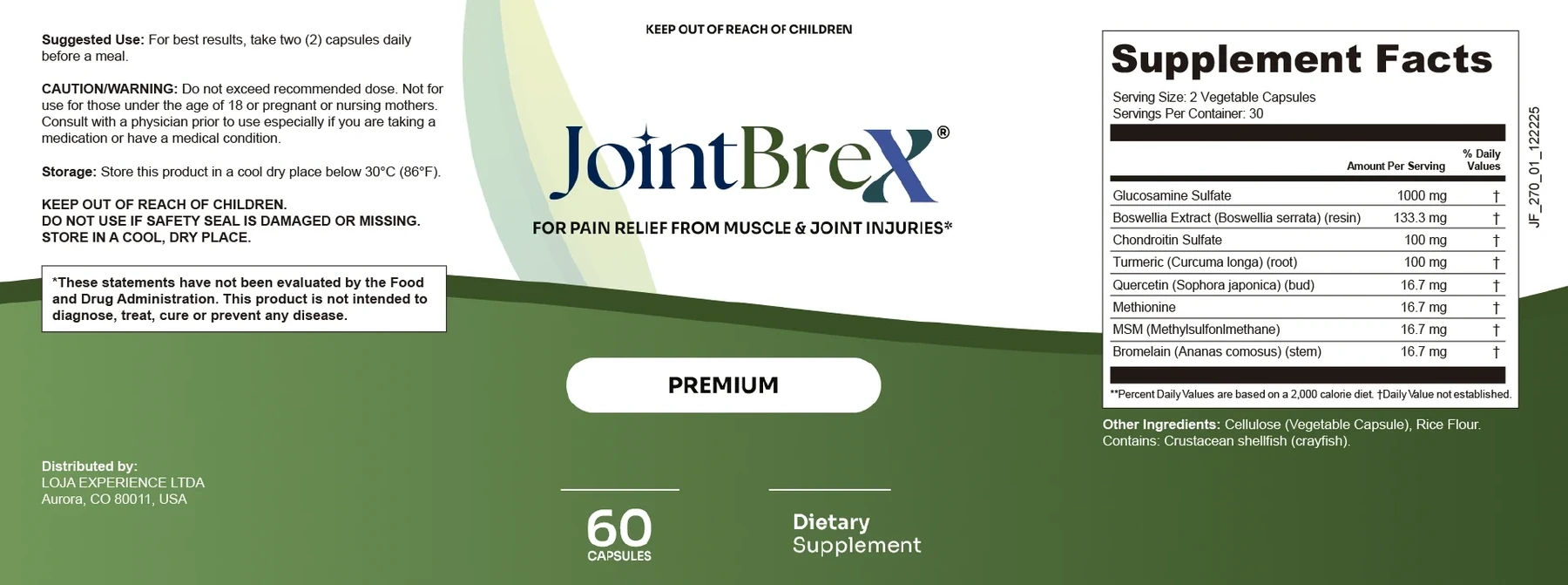
Boswellia is the fourth line on the JointBrex panel by weight: Boswellia Extract (Boswellia serrata, resin) 133.3 mg, marked with the dagger that means Daily Value not established, and worth 9.5% of the 1,400 mg serving. That much is on the Supplement Facts page, transcribed from the label artwork.
What is not on the panel is the one figure that turns 133.3 mg into a comparable number: a percentage of boswellic acids, an extraction ratio, or the name of the specific acid the extract is enriched for. The panel says resin and it says 133.3 mg. It does not say what fraction of that 133.3 mg is the active constituent class the knee-osteoarthritis trials were built around.
This is product information, not clinical guidance, and JointBrex is a supplement rather than a therapy. A joint that is hot, swollen, locking, or worsening week by week calls for an examination rather than a purchase; NIAMS sets out what is worth reporting.
What “boswellic acids” and AKBA mean
Boswellia serrata gum resin contains a family of pentacyclic triterpene acids collectively called boswellic acids. Several are studied for anti-inflammatory activity, and one in particular — 3-O-acetyl-11-keto-β-boswellic acid, abbreviated AKBA — is usually singled out as the most potent inhibitor of 5-lipoxygenase, an enzyme in the inflammatory pathway the extract is thought to act on.
That distinction matters because raw resin is not mostly boswellic acid. A crude gum resin extract can carry anywhere from a few percent to several tens of percent of total boswellic acids depending on how it was processed, and AKBA is typically a small fraction of that total again. A manufacturer who wants a reader to know what they are buying states the percentage. A manufacturer who states only the milligram weight of the resin extract is not telling you how much of it is the ingredient the trials measured.
Two ways a boswellia extract gets standardized
Reading the trial literature, two different standardization conventions show up, and they are not interchangeable.
Standardized to total boswellic acids
An extract labelled as a percentage of total boswellic acids — commonly around 65% in the trials that describe it — is being measured across the whole acid family at once. This is the older, more traditional convention.
Standardized to AKBA specifically
An extract like 5-Loxin® is instead enriched for one acid, AKBA, and its percentage — 30% in the trials below — describes only that single compound, not the total boswellic-acid content.
Neither one, unlabelled
A resin extract with a milligram weight and no percentage of either kind, which is what this panel prints, cannot be placed in either convention. It could be a light extract that is mostly inert plant material, or a concentrated one. There is no way to tell from the label.
A 2011 trial of Aflapin®, a Boswellia-derived composition, describes the comparator category directly as “the existing Boswellia products, 5-Loxin®, and traditional 65% Boswellia extract” — three named categories, two of them carrying a stated standardization and one of them a specific compound percentage. JointBrex's panel line does not identify with any of the three.
Three trials, three numbers
The clinical literature behind boswellia and knee osteoarthritis is smaller than the literature behind glucosamine, and three trials carry most of the weight. All three used a stated, single-acid standardization; none of them used unstandardized resin.
| Trial | Extract | Standardization | Dose | Duration |
|---|---|---|---|---|
| Sengupta et al. 2008 | 5-Loxin® | 30% AKBA | 100 mg or 250 mg/day | 90 days |
| Sengupta et al. 2010 | 5-Loxin® vs Aflapin® | 30% AKBA (5-Loxin); proprietary composition (Aflapin) | 100 mg/day, either extract | 90 days |
| Vishal et al. 2011 | Aflapin® | Proprietary composition | 100 mg/day | 30 days |
The 2008 trial randomised 75 knee-osteoarthritis patients to 100 mg or 250 mg of 5-Loxin® or placebo for 90 days and reported statistically significant improvement in pain and function at both doses, with the 250 mg arm improving as early as day 7, alongside a measured drop in synovial-fluid matrix metalloproteinase-3. The 2010 trial put 5-Loxin® and Aflapin® head to head at the same 100 mg dose against placebo over 90 days; both extracts improved pain and function, with Aflapin® performing somewhat better. The 2011 trial gave Aflapin® alone at 100 mg for 30 days and reported improvement as early as day 5.
In every one of the three, the dose is specific, the extract is named, and the standardization is stated. That is what lets the trial's mg figure mean something: 100 mg of 5-Loxin® is 100 mg of a resin extract that is 30% AKBA by weight, not 100 mg of an unspecified resin that might be almost anything.
133.3 mg against the trial doses
Set the panel figure next to the three trials and the honest picture is this: 133.3 mg sits between the 100 mg dose used in all three trials and the 250 mg dose used in the 2008 trial's higher arm. As a milligram figure alone, it is squarely inside the range that produced a measured result.
That last column is the whole article. A reader can do the arithmetic on the weight in about ten seconds. What cannot be done — not by this reader, not by anyone, without more information than the label supplies — is the arithmetic on potency. If the 133.3 mg on this panel happens to be a 30% AKBA extract, it is a genuinely comparable dose to the trials above. If it is an unstandardized resin at, say, 2–5% total boswellic acids, the active-compound content could be a tenth of what any of the three trials delivered inside the same milligram figure. The label does not resolve the question either way.
The glucosamine line on this panel is a shortfall you can measure exactly: 1,000 mg against a studied 1,500 mg, two numbers on the same known ingredient. The boswellia line is a different kind of gap — not a shortfall against a known trial amount, but a milligram figure that cannot be matched to a trial amount at all, because the one piece of information that would let you match them is missing.
What “resin” alone does and doesn't tell you
The panel's parenthetical — Boswellia serrata, resin — tells you the plant species and the plant part, which rules out confusion with a leaf or bark preparation and confirms this is the traditional gum-resin source the trials also used. That is real information and it is worth crediting.
What it does not tell you is the extraction method, the solvent, the extraction ratio (how many kilograms of raw resin produced one kilogram of extract), or the resulting concentration of any active compound. Two manufacturers can both write “Boswellia serrata, resin extract” on a label and sell products that differ several-fold in boswellic-acid content, because the phrase describes the source material, not the finished extract's strength.
Why the 2024 meta-analysis found so much noise
A 2024 systematic review and meta-analysis pooled 13 studies of Boswellia oleogum-resin extracts in knee osteoarthritis, covering 850 patients on the WOMAC scale and 1,185 on the VAS pain scale. The pooled result across all 13 studies did not reach statistical significance, which the authors attributed to high heterogeneity between the studies (p = 0.0865 for WOMAC, p = 0.3966 for VAS). A subgroup analysis, however, did find a significant benefit of Boswellia extracts over placebo, confirmed again in a meta-regression on the WOMAC scores.
That heterogeneity is not a mystery once you know what varies between boswellia products: extraction method, total boswellic-acid content, AKBA content, and dose, none of which are standardized across the category the way glucosamine sulfate or chondroitin sulfate are. A meta-analysis pooling studies of chemically different things under one plant name is exactly where you would expect the overall estimate to wash out while a subgroup of better-characterized products still shows an effect. It is also exactly the situation an unlabelled standardization on a retail panel drops a buyer into: which subgroup is this 133.3 mg actually in?
How to check any boswellia label in about a minute
- Look for a percentage next to the extract name. “Boswellia serrata extract (65% boswellic acids)” or “standardized to 30% AKBA” are both real, checkable claims. A bare milligram figure with no percentage is not.
- Note which acid the percentage describes. Total boswellic acids and AKBA specifically are not the same number, and a label that says only “boswellic acids” without naming AKBA may be using the broader, larger figure.
- Compare the milligram weight to a trial only once you know the standardization matches. 100 mg of a 30% AKBA extract and 100 mg of an unstandardized resin are not the same purchase even though the label weight is identical.
- Check for a trademarked extract name such as 5-Loxin® or Aflapin®, which at least identifies a specific, published formulation rather than a generic description.
Run that checklist on this panel and the result is: species and plant part confirmed, milligram weight stated and within the range of three real trials, standardization absent. Two out of three is not nothing, and it is also not enough to say the dose matches the evidence.
Order JointBrex with the missing number in view
133.3 mg of Boswellia extract, printed on the panel alongside the other seven amounts, standardization not stated.
One bottle $89 · six bottles $294 · 60-day money-back guarantee
Order JointBrex1,400 mg a serving across eight printed lines · dispatched inside the United States
So what is 133.3 mg buying?
Three honest things can be said, and a fourth cannot.
- The weight is in the right range. 133.3 mg sits between the 100 mg and 250 mg doses used across three published trials of standardized Boswellia extracts in knee osteoarthritis. That is a real point in the panel's favour, and it is more than some multi-ingredient joint formulas manage on any of their botanical lines.
- The source is the traditional one. “Boswellia serrata, resin” matches the gum-resin material every cited trial also used, rather than a different plant part.
- The standardization is the missing link. Without a stated percentage of boswellic acids or AKBA, 133.3 mg of this resin cannot be confirmed as equivalent, in active-compound terms, to 100 mg or 250 mg of 5-Loxin® or Aflapin®. It might be very close. It might be a fraction of the potency. The label does not let a reader tell which.
- What cannot be said is that this line either matches or falls short of the trial doses in the way the glucosamine line demonstrably does. There is no arithmetic to do here, because one of the two numbers the arithmetic needs was never printed.
The full ingredient-by-ingredient comparison, including where this line sits against the rest of the panel, is on the JointBrex ingredients page, and the panel itself is transcribed in full on the Supplement Facts page.
- Sengupta K, Alluri KV, Satish AR, et al. A double blind, randomized, placebo controlled study of the efficacy and safety of 5-Loxin for treatment of osteoarthritis of the knee. Arthritis Res Ther. 2008;10(4):R85. PMID 18667054. https://pubmed.ncbi.nlm.nih.gov/18667054/
- Sengupta K, Krishnaraju AV, Vishal AA, et al. Comparative efficacy and tolerability of 5-Loxin and Aflapin against osteoarthritis of the knee: a double blind, randomized, placebo controlled clinical study. Int J Med Sci. 2010;7(6):366-77. PMID 21060724. https://pubmed.ncbi.nlm.nih.gov/21060724/
- Vishal AA, Mishra A, Raychaudhuri SP. A double blind, randomized, placebo controlled clinical study evaluates the early efficacy of Aflapin in subjects with osteoarthritis of knee. Int J Med Sci. 2011;8(7):615-22. PMID 22022214. https://pubmed.ncbi.nlm.nih.gov/22022214/
- Dalmonte T, Andreani G, Rudelli C, Isani G. Efficacy of Extracts of Oleogum Resin of Boswellia in the Treatment of Knee Osteoarthritis: A Systematic Review and Meta-Analysis. Phytother Res. 2024;38(12):5672-5689. PMID 39314013. https://pubmed.ncbi.nlm.nih.gov/39314013/
- National Institute of Arthritis and Musculoskeletal and Skin Diseases. Osteoarthritis. U.S. National Institutes of Health. https://www.niams.nih.gov/health-topics/osteoarthritis