JointBrex Official Website › Articles › Safety
SafetyReading The JointBrex Caution Line: Who The Warning Is Actually For
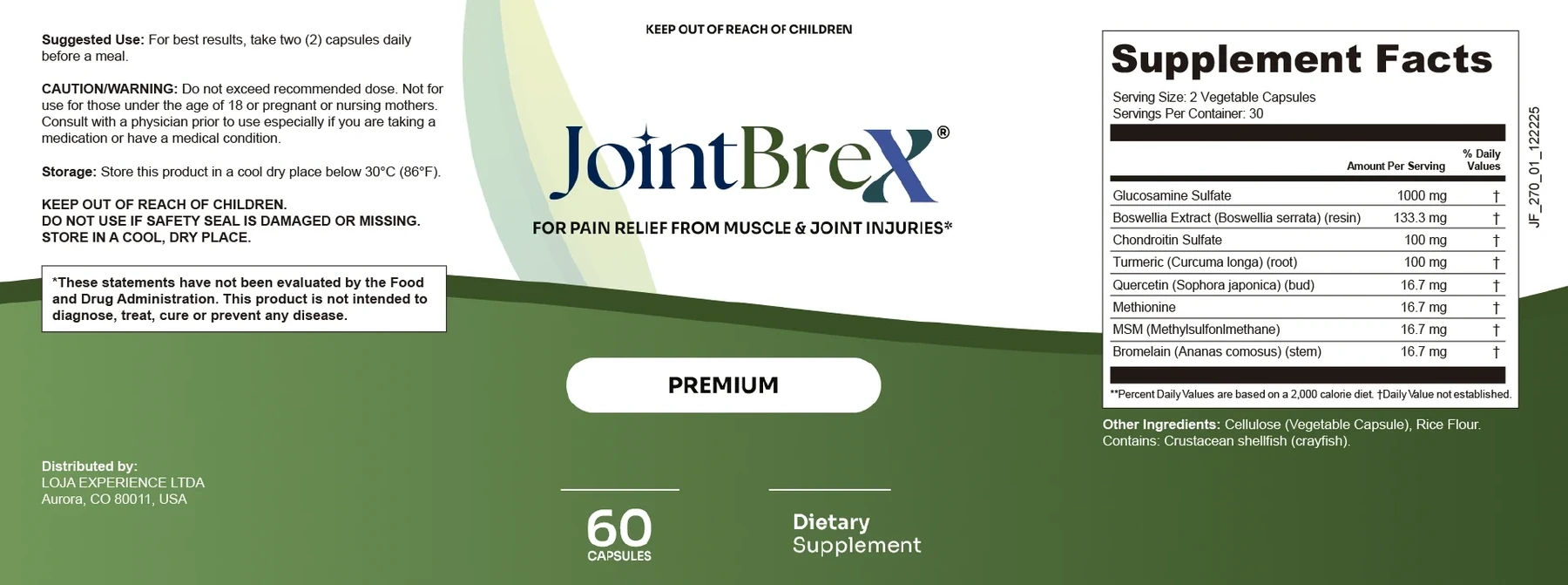
The printed CAUTION/WARNING line rules out three groups by category — under 18, pregnant or nursing, and no more than the stated dose — and asks a fourth group, anyone on medication or with a medical condition, to check with a physician first. That fourth instruction is generic on the label, but it is not generic in the literature: at least three of the eight ingredients have specific, citable reasons behind it.
The line as printed, in full
“Do not exceed recommended dose. Not for use for those under the age of 18 or pregnant or nursing mothers. Consult with a physician prior to use especially if you are taking a medication or have a medical condition.”CAUTION/WARNING, as printed on the JointBrex label artwork
That single paragraph, transcribed in full on the Supplement Facts page, is doing four separate jobs in three sentences: a dosing limit, an age exclusion, a pregnancy/nursing exclusion, and a catch-all instruction to check with a physician. Each one is worth taking on its own terms rather than reading past as boilerplate.
This is product information, not medical advice, and nothing here should be read as a recommendation to start, stop or combine any medication. Anyone with a specific health condition or prescription should raise this label with the clinician who manages it, which is the entire point of the line this article is about.
Not for those under 18
This part of the line is the least contestable. None of the trials cited on this website — for glucosamine, chondroitin, boswellia, turmeric, MSM, bromelain or quercetin — enrolled minors, because knee osteoarthritis in the population these trials studied is overwhelmingly a condition of adults. There is no dosing study to point to for a younger age group, and no version of this product formulated or labelled for one. The label's own line and the state of the evidence agree completely here: this is an adult product, full stop.
Not for pregnant or nursing mothers
The same absence of data applies here, for the same structural reason: osteoarthritis trials, as a matter of standard practice, exclude pregnant and nursing participants, so none of the eight ingredients on this panel has been studied in pregnancy at the amounts this label uses. That alone is sufficient grounds for the exclusion — a product cannot be shown safe in pregnancy by trials that never included a pregnant participant.
Two of the eight ingredients carry additional, independent caution in this area beyond the absence of trial data: turmeric and bromelain are both flagged in standard pharmacology references for a theoretical uterine-stimulant or anticoagulant-adjacent caution in pregnancy, on top of simply lacking safety data. The label's blanket exclusion covers this without needing to name which ingredient is responsible, which is exactly what a conservative, structure/function warning line is supposed to do.
There is also a plain dosing point worth stating on its own: “do not exceed recommended dose” is the first sentence of the caution line, ahead of any of the exclusions, and it applies regardless of age, pregnancy or medication status. Two capsules is the studied amount for this specific formula — the only amount any of the label’s own directions describe — and none of the trials behind the eight individual ingredients found a faster or better result from a larger amount. Taking four capsules because two did not seem to do much in the first fortnight is precisely what this first sentence rules out, and it is worth reading as carefully as the three exclusions that follow it.
Consult a physician if taking a medication
This is the part of the line that rewards being specific rather than generic, because at least three of the eight panel ingredients have a citable, mechanism-based or case-level reason for it.
Glucosamine and warfarin
A 2008 case report and MedWatch database review describes glucosamine raising the international normalised ratio — the standard measure of blood-thinning — in patients taking warfarin. Glucosamine sulfate is 1,000 mg of this panel's 1,400 mg serving, easily the largest single ingredient, which makes this the best-documented interaction reason on the whole label.
Bromelain and platelet aggregation
A widely cited 2001 pharmacology review describes bromelain's claimed properties as including “reversible inhibition of platelet aggregation” alongside antithrombotic and fibrinolytic activity. That is the mechanistic basis for pairing bromelain with a caution around blood-thinning medication, independent of any specific trial dose.
Turmeric and anticoagulants — a mixed picture
Curcumin carries a widely discussed theoretical antiplatelet caution. A 2018 clinical study measured bleeding time and INR in patients stable on aspirin, ticlopidine, clopidogrel, warfarin or dabigatran before and after 10 days of a bioavailable curcumin formulation and found no significant change in either measure. The caution is grounded in mechanism and in caution literature; the best available human interaction study found no effect at that trial's dose.
None of that means any of the three definitely interacts with a specific reader's medication at JointBrex's printed amounts — the warfarin case report involved glucosamine at typical supplement doses similar to this panel's 1,000 mg, while the curcumin non-interaction study used a specialised high-bioavailability formulation rather than the 100 mg of plain turmeric root printed here. What it does mean is that “consult a physician... if you are taking a medication” is not a throwaway line on this particular label. It is covering at least one well-documented case-level interaction (glucosamine/warfarin), one mechanism-based theoretical caution with reassuring but limited human data (turmeric), and one mechanism-based theoretical caution with a much lower dose than typically studied (bromelain, at 16.7 mg against 800 mg in the knee-osteoarthritis trials).
Take the panel — or a photograph of it — to whoever prescribes the medication, before the first capsule rather than after. Name the ingredient and the amount; the panel prints both, so there is nothing to estimate. This is especially worth doing for anyone on a prescribed anticoagulant or antiplatelet drug, given glucosamine's documented case report and bromelain and turmeric's theoretical caution.
Or have a medical condition
The second half of the consult-a-physician instruction is broader again, and two conditions have a specific, citable reason to appear here.
Diabetes and blood-sugar monitoring. Glucosamine is an amino sugar, and a 2006 literature review in the Annals of Pharmacotherapy concluded that small, short-term studies suggest glucosamine can be used in selected patients without affecting glucose control, but that data specifically in people with diabetes are limited and that close monitoring for potential changes in glucose control is recommended. That is a direct, citable reason for anyone managing diabetes to raise this product with whoever monitors their blood sugar before starting — not because harm is established, but because the review that looked specifically at this question said the evidence gap is real.
Liver conditions and turmeric. A 2023 case series from the Drug-Induced Liver Injury Network (DILIN) documented ten cases of liver injury associated with turmeric supplements. The amounts involved in those cases were generally far above the 100 mg of plain turmeric root on this panel, and several of the implicated products combined turmeric with piperine or other absorption enhancers that this formula does not contain — which meaningfully lowers the concern at this label's dose without erasing the reason the caution exists for anyone with pre-existing liver disease.
Both of these are conditions where “consult a physician” is not generic advice-shaped filler. It is the label pointing, without naming it directly, at two real and specific bodies of published evidence.
Order JointBrex once the caution line makes sense
Over 18, not pregnant or nursing, no outstanding medication question, and the panel amounts in hand for whoever needs to see them.
One bottle $89 · six bottles $294 · 60-day money-back guarantee
Order JointBrex1,400 mg a serving across eight printed lines · dispatched inside the United States
What this line is not: the shellfish declaration
It is worth being precise about what the caution line covers and what it doesn't, because the label carries a second, separate warning that this article is deliberately not about. The allergen statement — Contains: Crustacean shellfish (crayfish) — is an absolute exclusion tied to a specific allergy, not a conditional instruction to check with someone first. The shellfish declaration article on this site covers who that line rules out and what it does and doesn't identify about the source ingredient. This article is about the general CAUTION/WARNING paragraph and the medication-interaction reasoning behind it; the two lines sit on the same label but do different jobs, and conflating them would understate both.
What the warning does not do
Reading the label's caution line closely also means being honest about its limits.
- It does not name a single specific medication, ingredient or condition. It is written in the generic structure/function-labeling style common to dietary supplements, which is a regulatory convention, not a personalized risk assessment.
- It does not tell a reader which of the eight ingredients is responsible for the caution, or whether more than one is. That requires going to the primary literature, which is what this article and the Safety & Interactions page both do.
- It does not distinguish between a well-documented interaction (glucosamine and warfarin, backed by a published case report) and a theoretical, mechanism-based one with reassuring human data (turmeric's antiplatelet caution, tested directly and not confirmed at trial dose). Both get the same four words on the label.
- It is not a substitute for telling a prescriber what is actually being taken. A generic instruction to consult a physician only works if the physician is actually consulted, with the specific panel in hand.
How to actually use this line
The practical version of everything above is short. Anyone under 18, pregnant or nursing should treat the label's own exclusion as final, since none of the underlying trials included them either. Anyone on a prescribed medication — an anticoagulant or antiplatelet drug above all, given glucosamine's case report and bromelain and turmeric's theoretical caution — should bring the panel to that prescriber before the first capsule. Anyone managing diabetes or an existing liver condition has a specific, citable reason (glucosamine and blood-sugar monitoring; turmeric and the DILIN case series) to do the same rather than a generic one. And anyone checking the allergen line separately should read it as a different instruction covering a different risk, set out in full in the shellfish declaration article.
None of this amounts to a reason nobody should take this product. It amounts to what the label's own four sentences are actually asking a specific set of readers to do before they do.
Two questions this line raises
Does “consult a physician” mean this product is dangerous?
No — it is the standard, conservative instruction printed on essentially every multi-ingredient dietary supplement sold in the United States, precisely because a manufacturer cannot know every reader’s medication list. What makes it worth a closer read here is that, unlike a purely generic disclaimer, at least three of this panel’s eight ingredients have a specific, citable, published reason behind the instruction rather than none at all.
If I'm not on any medication, does the line still apply?
The age and pregnancy/nursing exclusions apply regardless of medication status, because they rest on the absence of trial data rather than on an interaction. The medication and medical-condition clause is the one that narrows to a smaller group — but “no prescriptions” does not by itself cover diabetes managed by diet alone or a liver condition not currently being treated with a drug, both of which the “or have a medical condition” half of the sentence is written to include.
- Knudsen JF, Sokol GH. Potential glucosamine-warfarin interaction resulting in increased international normalized ratio: case report and review of the literature and MedWatch database. Pharmacotherapy. 2008;28(4):540-8. PMID 18363538. https://pubmed.ncbi.nlm.nih.gov/18363538/
- Maurer HR. Bromelain: biochemistry, pharmacology and medical use. Cell Mol Life Sci. 2001;58(9):1234-45. PMID 11577981. https://pubmed.ncbi.nlm.nih.gov/11577981/
- Hu S, Belcaro G, Dugall M, et al. Interaction study between antiplatelet agents, anticoagulants, thyroid replacement therapy and a bioavailable formulation of curcumin (Meriva®). Eur Rev Med Pharmacol Sci. 2018;22(15):5042-5046. PMID 30070343. https://pubmed.ncbi.nlm.nih.gov/30070343/
- Stumpf JL, Lin SW. Effect of glucosamine on glucose control. Ann Pharmacother. 2006;40(4):694-8. PMID 16569816. https://pubmed.ncbi.nlm.nih.gov/16569816/
- Halegoua-DeMarzio D, Navarro V, Ahmad J, et al. Liver Injury Associated with Turmeric - A Growing Problem: Ten Cases from the Drug-Induced Liver Injury Network (DILIN). Am J Med. 2023;136(2):200-206. PMID 36252717. https://pubmed.ncbi.nlm.nih.gov/36252717/
- Kasemsuk T, Saengpetch N, Sibmooh N, Unchern S. Improved WOMAC score following 16-week treatment with bromelain for knee osteoarthritis. Clin Rheumatol. 2016;35(10):2531-40. PMID 27470088. https://pubmed.ncbi.nlm.nih.gov/27470088/